
Home / Resources / Roof blisters
Flat roof blisters: what causes them and when to repair
A blister is a raised pocket where the layers of a roof have let go of each other. Many sit harmlessly for years; others are the first sign that water is getting into the roof. Here's how to tell the difference on built-up, modified bitumen, single-ply and spray foam roofs.
What is a roof blister?
Roof blisters are bubbles in the roof surface. Somewhere in the assembly, two layers that should be bonded together have separated. The gap has filled with air, water vapor or both. Press on one and it may feel firm like a balloon, or soft and spongy. Some are smaller than your hand and some spread across a wide patch of roof. An older flat roof can have many in a single section.
Blisters are easy to confuse with other things you'll see on a low-slope roof, and the difference matters:
- Ridges are long, raised lines, usually over the joints between insulation boards. They form when boards move or moisture condenses at the joints.
- Wrinkles and fishmouths are folds or open edges at seams and laps, where a sheet was never fully bonded.
- Soft spots without a raised bubble usually mean crushed or wet insulation underneath, not a blister in the membrane.
- Billowing on a mechanically attached single-ply roof is the sheet lifting between fasteners in wind. It settles back down when the wind stops.
Why do blisters form?
Almost every blister starts with something trapped between layers: air, or moisture that later turns to vapor. That can happen during installation. A ply may not be fully set in bitumen, adhesive may miss a spot, or materials may go down damp. It can also happen later, when water gets in through a seam or flashing. Warm, humid air from inside the building can also work up into the roof and condense.
Sun does the rest. On a clear afternoon a dark roof gets very hot. The air and vapor in the pocket expand and push the layers farther apart. At night the pocket cools and shrinks, and if the top of the blister has cracked, it can draw in more air and moisture. Over seasons, a small blister can grow this way.
Colorado speeds the cycle. UV at altitude heats and dries roof surfaces hard. Summer afternoons swing quickly into cool nights, and freeze-thaw through the winter works at any crack in a blister's skin. A blister that cracks open in the spring is exposed to hail season, from mid-April to mid-August. A raised, stiff bubble can take a hailstone worse than the flat, well-bonded roof around it.
How do blisters differ by roof system?
Where a blister forms, and how much it matters, depends on how the roof is built.
Built-up roofs (tar and gravel)
On a built-up roof, blisters usually form between plies of felt. The cause is a void left in the bitumen or moisture trapped as the plies went down. Smooth-surfaced roofs show them plainly. On gravel-surfaced roofs they hide under the aggregate, and you may notice only a bare, raised patch where the gravel has rolled off.
A built-up roof has several plies, so a blister in the top plies often still has sound plies beneath it. That's one reason small, intact ones are often monitored rather than cut right away.
Modified bitumen
Modified bitumen is a close relative of built-up roofing. It's made of asphalt sheets that are torched, cold-applied or self-adhered, usually a base sheet with a granule-surfaced cap sheet on top. Blisters form between the cap and base sheets, or between the base sheet and the insulation. They start where heat or adhesive didn't fully bond the layers, or where moisture was trapped beneath them.
Granule loss over a blister exposes the asphalt to the sun, which dries and cracks it. If your building has a modified bitumen roof, an inspection shows whether its blisters matter. It also shows your repair and replacement options.
Single-ply TPO and EPDM
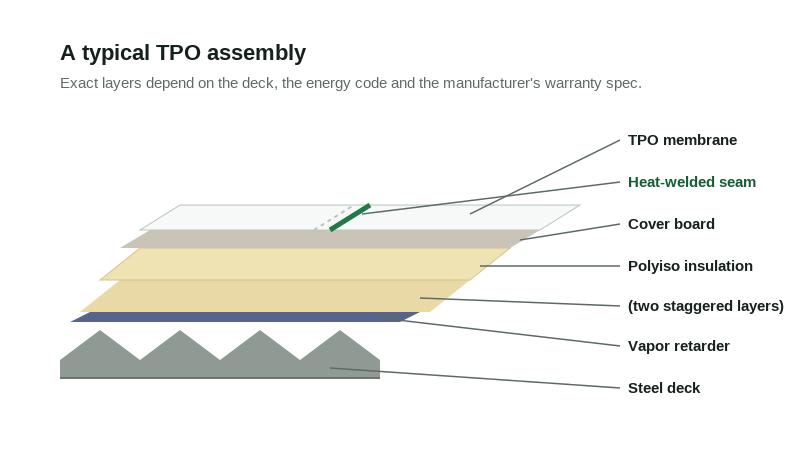
On a fully adhered TPO or EPDM roof, a bubble means the membrane has come loose from the board beneath it. The usual cause is adhesive that didn't bond in cold or damp conditions. Water under the sheet from a leak can do it too, and so can air pushed up from inside the building through gaps in the deck. A bubble along a seam is a different problem: an unbonded lap that can open into a leak. Our guide to TPO and EPDM seam failures covers those.
Spray foam (SPF)
On a spray foam roof, blisters can form in the coating where it went over damp or dirty foam. They can also form in the foam itself, where one pass didn't bond to the next or to the roof below. Soft or spongy blistered areas can mean the foam has lost its bond. Because the coating is what protects foam from the sun, a broken blister on a foam roof needs attention sooner. See spray foam roof repair and recoating.
| Roof system | Where blisters form | Common causes | What to check |
|---|---|---|---|
| Built-up | Between felt plies | Voids in the bitumen, moisture trapped during installation | Cracks in the top, soft plies, bare spots on gravel roofs |
| Modified bitumen | Between cap and base sheets, or under the base sheet | Incomplete bonding, damp insulation | Granule loss, cracking, blisters near laps |
| TPO and EPDM | Between the membrane and the board below | Adhesive failure, water under the sheet, air from inside | Size and growth, nearby seams, wet insulation |
| Spray foam | In the coating, or between foam layers | Coating over damp foam, poor bonding between passes | Broken coating, exposed foam, soft areas |
When do roof blisters matter?
Most of the work is sorting blisters into the ones you can watch and the ones that need repair. A blister becomes a priority when it is:
- Cracked or open. Water can now get into the pocket and from there into the plies or insulation.
- Soft, spongy or wet. Water in or under the blister usually means the insulation around it is wet too.
- Growing. A blister that's bigger at each inspection is still being fed with air or moisture.
- In a traffic path. Blisters on the route to rooftop units, hatches and drains get stepped on and broken.
- At a seam, flashing or drain. A blister that reaches a detail can open the detail with it.
- Part of a wider pattern. Widespread blistering across a section points to a problem in the whole assembly, often moisture.
Small, firm, intact blisters away from seams and traffic are common, especially on older built-up roofs, and they're often left alone and watched. The point is to know which kind you have, and to have them marked and measured so a change shows up.
What not to do: roof maintenance tips for blisters
- Don't pop the blister. Puncturing a blister lets water into a pocket that was dry, and the hole rarely gets sealed properly.
- Don't cover it with mastic. Roof cement smeared over a blister hides it, can harm single-ply membranes and makes the real repair harder.
- Keep foot traffic off it. Keep staff and vendors off blistered areas, and keep anyone off the roof who isn't trained and equipped for fall protection.
- Leave the repair to an authorized roofer. A blister roof repair by someone the manufacturer hasn't authorized can affect a warranty.
How does roof blister repair work?
A lasting repair finds out what's in the blister and underneath it before anything is patched.
Check what's inside
The blister is opened or a core is cut nearby to see whether the pocket and the insulation below are dry or wet.
Remove the blistered layers
The loose material is cut out back to well-bonded roof, and any wet insulation or cover board beneath it comes out too.
Rebuild with matching materials
The patch matches the roof: new plies set in compatible bitumen on a built-up roof, a welded patch on TPO or a primed and taped patch on EPDM. On spray foam it's new foam and coating. The surfacing goes back on top.
Fix the cause
If water got in at a seam or flashing, that detail gets repaired. If moisture is coming from inside the building, the long-term fix may be part of a replacement design.
Record it
Photos and a location on the roof plan, so the next inspection can confirm the repair is holding.
When blisters are widespread, the question changes from "how do we fix these?" to "how much of this roof is wet?" An infrared moisture survey, confirmed with core cuts, maps the wet areas so you can price the options. Our guide to wet insulation under a flat roof explains what comes next. Recover vs tear-off covers why a new roof can't simply go over a blistered, wet one.
Are roof blisters hail damage?
Blisters are usually a sign of age, installation or moisture, not storm damage. That matters after a hailstorm, when the adjuster has to separate new damage from conditions that were already there.
A blister cracked open by hail looks different from one that has been weathering for years. Dated photos from a recent inspection are the clearest way to show which is which. See how to document hail damage on a commercial roof. Policies vary, so check yours with your agent.
How do you track blisters between inspections?
Blisters change slowly, which makes them a good fit for routine maintenance. The NRCA recommends inspecting low-slope roofs at least twice a year and after severe weather. On our S.M.a.R.T. maintenance program visits we mark and measure blisters and photograph them in the same locations each time. We note any that have cracked, softened or grown, so a decision to repair is based on change, not guesswork. Every visit ends with a written report.
If water is already coming in under a blistered area, call us first at (720) 296-0000 or report a leak. Otherwise, we inspect commercial and association roofs across the Denver metro, from office parks in the Denver Tech Center to condo buildings near our home base. Learn more about our commercial roofing in Centennial and our roof inspections and infrared surveys. Then request an inspection and we'll tell you which blisters can wait.
Roof blister FAQs
Is a blister on our roof an emergency?
Usually not. Small, firm, intact blisters are common and are often monitored rather than cut. A blister becomes a priority when it's cracked, soft, growing, in a walkway or near a seam, flashing or drain. If water is coming inside, call us first.
Can we just pop a blister to flatten it?
No. Puncturing a blister opens a path for water into a pocket that was dry. If a blister needs repair, the loose layers are cut out and rebuilt with materials that match the roof.
Do blisters mean our roof needs to be replaced?
Blisters alone don't mean replacement. A few blisters on an otherwise sound roof are a repair. Blistering across a whole section points toward replacing that section or the roof, especially with wet insulation underneath. An infrared survey with core cuts shows which.
Why do blisters get bigger in summer?
Heat. Strong sun warms the trapped air and vapor and they expand, pushing the layers apart. At night the pocket cools. Over many hot days and cool nights, a blister can grow, especially if its top has cracked.
Can a new roof go over a blistered roof?
Only if the existing roof is dry and code allows another layer. Blistered areas have to be cut out and prepared first, and wet insulation must come out. A moisture survey answers whether a recover is an option.
Is blister damage covered by insurance?
Policies vary, so check yours with your agent. Blisters themselves usually come from age, installation or moisture rather than a storm. We document roof conditions with photos and can prepare a detailed scope of any storm damage we find.