
Home / Resources / Built-up vs single-ply
Built-up roofing vs single-ply membranes
A built-up roof stacks several plies of felt and bitumen into one thick membrane. A single-ply roof uses one engineered sheet, TPO or EPDM. Both work on Front Range buildings. Here's how they differ, and how to decide which belongs on yours.
What are the two approaches to a flat roof?
Your low-slope roof needs a continuous waterproof layer, because water moves slowly across it. Commercial roofing solutions build that layer in one of two basic ways.
Built-up roofing (BUR) relies on redundancy. Several plies of reinforcing felt are set in bitumen, one on top of the next. If the top layer is damaged, the plies below keep water out. It's the original flat roof, and it still covers many older offices, schools, warehouses and condo buildings around Denver.
Single-ply membranes rely on one factory-made sheet with tightly controlled thickness and quality, joined at the seams on site. TPO is white with heat-welded seams. EPDM is a synthetic rubber, usually black, with taped seams. Together they make up most new low-slope roofs and re-roofs today.
How is a built-up roof built?
Crews lay alternating layers of bitumen and felt, usually three to five plies, over insulation or the deck. Each ply is set in hot asphalt from a kettle or in a cold-applied adhesive. The top is finished one of two ways:
- Gravel-surfaced ("tar and gravel"): a heavy flood coat with aggregate embedded in it. The gravel shields the bitumen from sun and hail and takes foot traffic well.
- Smooth-surfaced: a coating or a mineral-surfaced cap sheet. It's lighter and easier to inspect, but more exposed, and it needs recoating to stay healthy.
Older roofs may use coal tar pitch instead of asphalt. The two aren't compatible, so repairs have to match. Modified bitumen is a close relative. It comes as asphalt sheets that are torched, cold-applied or self-adhered, and it's often used on smaller roofs and details. Our built-up roofing page covers the system in depth.
How is a single-ply roof built?
A single-ply roof is an assembly of three layers. Insulation goes down first, often tapered toward drains. A cover board protects it from hail and foot traffic, and the membrane goes on top. The membrane is held down by fasteners and plates, by adhesive, or, on some EPDM roofs, by stone ballast. The flashings at walls, curbs and penetrations use the same material.
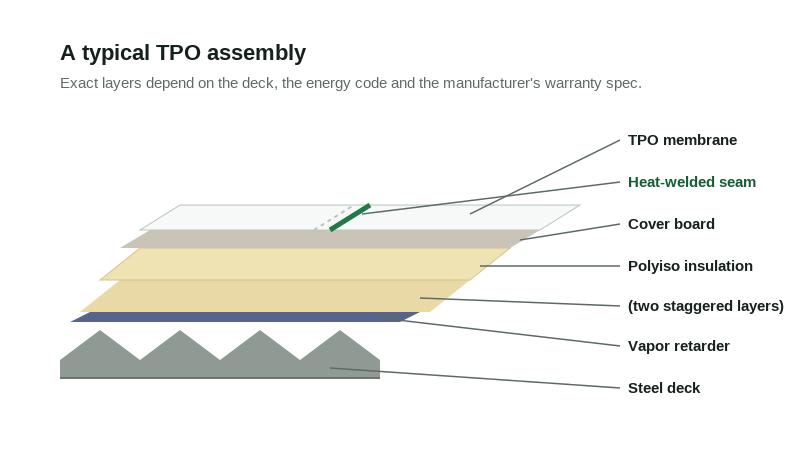
- TPO seams are fused by a hot-air welder into one continuous sheet and can be probed and tested the day they're made. The white surface reflects much of the summer sun.
- EPDM comes in large sheets with fewer seams, stays flexible in deep cold and is simple to patch at almost any age.
For a closer look at the two single-plies, see TPO vs EPDM.
How do they compare side by side?
| Factor | Built-up (BUR) | Single-ply (TPO or EPDM) |
|---|---|---|
| Waterproofing | Several plies; redundancy if the top layer is damaged | One sheet; seams and flashings carry the risk |
| Weight | Heavy, especially with gravel | Light, unless EPDM is ballasted |
| Foot traffic | Gravel surface takes traffic well | Needs walkway pads on service routes |
| Hail | Gravel shields the bitumen; smooth surfaces are more exposed | Depends on cover board, thickness and attachment; ballast shields EPDM |
| Sun and heat | Gravel protects; smooth surfaces need recoating | White TPO reflects; black EPDM absorbs heat |
| Installation | Hot kettles or cold adhesives; odor and hot-work permits to plan | Less odor with welded or fastened systems; adhesives have temperature limits |
| Finding leaks | Harder under gravel; water can travel between plies | Easier on an exposed sheet; harder under ballast |
| Repairs | Cut out and re-ply; materials must match asphalt or coal tar | Welded TPO patches or primed EPDM patches |
| Typical planning life | Roughly 20–30 years | TPO roughly 15–25 years or more; EPDM roughly 20–30 years |
Treat these planning ranges as general figures for reserve and capital budgets, not promises. Installation quality, drainage, hail history and maintenance can move your roof's life in either direction.
When does built-up roofing make sense?
- An existing built-up roof with good plies and dry insulation. Restoration, with repairs and a fresh flood coat and gravel or a compatible coating, can add years for far less than replacement.
- Roofs with heavy rooftop traffic, where a gravel surface stands up better than a bare sheet.
- Owners who want multiple layers of redundancy and have a structure built to carry the weight.
When does single-ply make sense?
- Most full replacements on offices, retail, medical and multifamily buildings.
- Buildings where weight matters. A single-ply assembly weighs far less than gravel and plies, which can make a recover possible on an older structure.
- Cooling-heavy buildings and cool-roof requirements. White TPO lowers summer heat gain. And Denver's green building rules can require a cool roof on larger buildings at replacement.
- Occupied sites where odor is a concern, such as clinics, schools in session and residential communities.
- Matching existing systems across your community or portfolio, so repairs and maintenance stay simple.
How does Colorado weather tip the choice?
- Hail, mid-April to mid-August. Gravel absorbs a lot of hail energy. A smooth built-up surface, by contrast, can fracture and lose surfacing. On single-ply, a dense cover board and good attachment do most of the work. See our guides to hail on built-up, TPO and EPDM roofs.
- UV at altitude. Exposed bitumen oxidizes and alligators, so smooth built-up roofs need regular recoating. Single-ply membranes are formulated for UV, but their flashings and seam edges still age fastest.
- Freeze-thaw. Trapped moisture grows blisters and splits in built-up roofs. On single-ply, freeze-thaw works at seams and terminations, which is why seam failures are a common winter repair.
- Chinook winds. Gusts scour gravel from corners and edges, leaving bare bitumen. On single-ply, uplift at corners and perimeters calls for added attachment and tested edge metal.
- Snow loads on older structures. Gravel and plies are already heavy before the snow arrives. Any recover over an existing roof needs a structural check.
What should you do with an old built-up roof?
Many of the built-up roofs we see are decades old. The question isn't which system is better in theory. It's what to do with the roof you have. Your flat roofing options start with moisture. An infrared moisture survey and core cuts show how much is wet and how many roofs are already on the building.
- Dry and sound: you can restore the built-up roof. Or you can recover it with a single-ply membrane over a cover board, once loose gravel is removed and the surface is prepared. A dry built-up roof is also a good base for a spray foam recover.
- Widely wet, or already two roofs: tear off to the deck and install a new system, built-up or single-ply. A tear-off generally has to meet current energy code insulation levels. That can change your curb, flashing and edge heights.
- Older materials: some older built-up roofs contain asbestos in felts, mastics or flashing cement. Where Colorado rules require it, those materials have to be tested before tear-off.
Our guide to roof recover vs tear-off covers that decision in detail.
What drives cost?
When you compare systems, the assembly usually matters more than the top layer. Your cost depends on tear-off and disposal, gravel removal, wet insulation and deck repair. It also depends on code-required insulation, tapered insulation for drainage, flashings and sheet metal, access, rooftop equipment and the warranty you want. Built-up work also carries kettle logistics and hot-work permits. Our commercial roof cost factors guide breaks these down.
How is maintenance different?
On a built-up roof, maintenance means re-embedding scoured gravel and tracking blisters. It also means recoating smooth surfaces and keeping base flashings and pitch pans sealed. On single-ply, maintenance means probing seams and checking flashings and terminations. It also means repairing punctures from service work and keeping walkway pads in place.
Either way, the NRCA recommends inspecting low-slope roofs at least twice a year and after severe weather. Our S.M.a.R.T. maintenance program covers both systems, and you get a written report after every visit.
Whether your building is commercial or association-owned, we repair, restore and replace built-up, TPO and EPDM roofs across the metro. See our commercial roofing in Centennial and Denver, then request an assessment. We'll lay out restoration, recover and replacement side by side for you.
Built-up vs single-ply FAQs
Is built-up roofing outdated?
No. It's an older system, but a well-built gravel roof with good plies still performs. Restoring a dry one is often the most economical choice. For most full replacements today, owners choose single-ply.
Which handles hail better?
A gravel-surfaced built-up roof shields its bitumen well. A single-ply roof's hail performance depends on the cover board, membrane thickness and attachment. Smooth built-up surfaces are more exposed than either.
Can a single-ply roof go over our built-up roof?
Often, if the built-up roof is dry, it's the only roof on the building and loose gravel is removed first. A moisture survey and core cuts decide it.
Will the kettle smell get into our building?
Hot asphalt has an odor. We plan kettle placement around air intakes and coordinate rooftop units with your facility staff. Where odor would be a problem, we use cold-applied or low-odor products.
Can we mix systems on one property?
Yes, and many communities already do. Keep a roof inventory by building, with system, age and condition. It keeps maintenance and reserve planning accurate.