
Home / Resources / Hail on TPO roofs
TPO roof hail damage: how to spot it
Hail rarely punches a clean hole through TPO. It crushes what's underneath, cracks the membrane over hard spots and leaves marks that may or may not matter. Here's where hail damage shows up on a white TPO roof, how inspectors find it and how it's repaired.
How does a TPO roof take a hailstone?
TPO is a white, reinforced single-ply membrane. It's laid over insulation and, on a well-built roof, a dense cover board. Every seam is fused with a hot-air welder. It's the most common choice for new low-slope roofs on offices, retail centers, warehouses and multifamily buildings around the Denver metro. So it's on many of the roofs a Front Range hailstorm crosses.
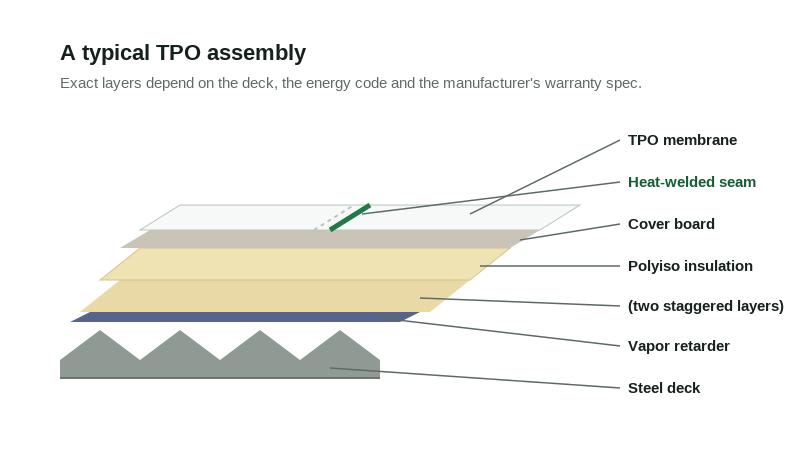
When hail hits TPO, the membrane usually flexes and the layers below take the blow. The insulation compresses or its facer fractures, leaving a soft spot. The membrane may look fine that day.
Over the following months, foot traffic, snow load and freeze-thaw flex the sheet over that soft spot until it cracks. That's why hail damage on TPO so often leaks long after the storm.
How much damage a given storm does depends on the assembly as much as the hail:
- Cover board. A dense board between the insulation and the membrane spreads out the blow. Roofs without one show more crushed insulation.
- Attachment. Fully adhered and fleece-backed roofs hold up best. On mechanically fastened roofs, the sheet is looser and the fastener plates give it hard points to break against.
- Age. UV at altitude wears TPO from the top down, thinning the layer above the reinforcing scrim. Older, weathered membranes crack more readily under impact.
For more on the assembly, see our page on TPO roof installation and repair.
What can you check without going on the roof?
Leave the roof to a crew with fall protection. Wet TPO is slick, and hail can hide edges and skylights. Every extra set of footprints also adds marks an adjuster then has to sort out. From the ground and inside, record:
- Dents in gutters, downspouts, edge metal, vents, signs and ground-mounted condensers, with a wide shot and a close-up of each
- Damaged rooftop equipment or skylights you can see from a distance
- Ceiling stains, wet tiles and damp finishes on top floors, with the date each appeared
- The storm's date, time and the largest hail anyone saw
Our checklist for the first 72 hours after a hailstorm covers safety, leaks and insurance notice.
Where does TPO roof hail damage show up?
Soft spots over crushed insulation
The most common and least visible damage. Inspectors walk the field in a pattern, feeling for areas that give underfoot. They mark each one and photograph it with a scale. A scatter of soft spots across the open field, in line with the storm's direction, points toward hail.
Cracks and fractures in the membrane
Look for small circular, crescent or star-shaped cracks at impact points. They're more likely on older membranes and over hard spots. Watch fastener plates, seam laps, the edges of insulation boards and anywhere the membrane bridges a gap. On a dirty roof they can be hard to see, so inspectors clean suspect impacts and examine them up close.
Punctures and cuts
Large hail can punch straight through TPO. A hit right over a fastener plate can also cut the sheet from below. Each puncture is an open path to the insulation.
Seams, laps and T-joints
A properly welded seam is as strong as the sheet, so hail rarely opens a good weld. It can expose a weak one.
Inspectors probe seams where impacts are heaviest. They pay close attention to T-joints, where three layers meet. Seams that open under a probe along long runs usually point to installation, not hail. Our guide to seam failures on TPO and EPDM roofs covers the causes.
Flashings, curbs and penetrations
Welded flashings at walls and curbs, factory-made pipe boots and pitch pans take hail without insulation behind them. Split boots and cracked curb flashings are frequent findings, and some of the most likely to leak. For the equipment itself, see hail damage to rooftop HVAC units, skylights and vents.
Marks that show hail hit, but aren't damage
White TPO collects dirt, and hail often knocks it off in clean round spots. These spatter marks are useful evidence. Their size and spacing show how big the hail was and which way it came from.
But a clean spot on an intact, firm membrane isn't damage by itself. Hail marks are only part of the story. What matters is whether the membrane, the insulation or the details beneath them were harmed. Our guide to functional vs cosmetic hail damage explains why that distinction matters for the claim.
Hail damage or something else?
Plenty of TPO punctures have nothing to do with hail: HVAC service work, dropped tools and snow shovels cause many of them. Adjusters know that, so a good inspection separates the causes honestly:
| What you see | Points toward hail | Points toward another cause |
|---|---|---|
| Punctures and cuts | Scattered across the open field, with soft spots and spatter marks nearby | Clustered around rooftop units and paths to them: dropped screws, tools, panels and snow shovels |
| Soft spots | A random pattern in line with the storm | Large soft areas around drains, curbs or old leaks, where insulation has been wet for a long time |
| Seam openings | Isolated openings where impacts are densest | Long runs that open under a probe, from underwelding at installation |
| Surface wear | Fresh fractures at impact points | General thinning, chalking or exposed scrim from years of sun |
| Soft metals | Fresh dents on vents, edge metal and gutters consistent with the storm | Old dents, corrosion and paint wear |
Dated photos from a spring inspection make this much easier. See our guide to documenting hail damage before the adjuster arrives.
What does a TPO roof damage inspection include?
Map and number the roof
Every building and roof section gets a label that goes on every photo, note and estimate line.
Mark impacts and soft spots
Chalked and photographed with a scale, with overview shots that show where each close-up was taken.
Test cuts at suspect impacts
Small cuts show crushed insulation, a fractured facer or cracked cover board. Each is photographed open and again after it's patched watertight.
Seams and details
Seam probing through impacted areas, plus flashings, boots, curbs, drains and edge metal.
Moisture where needed
If water may have gotten in, an infrared moisture survey maps the wet insulation, and core cuts confirm it.
A written report
You get findings by building and section, test cut results, moisture findings and an honest note of existing conditions.
If you have a large or multi-building property, drone imagery gives you an overhead record of whole roof areas. See our inspections and infrared surveys page for more on how we work.
How is hail damage repair done on a TPO roof?
- Welded patches. We cover fractures and punctures with welded TPO patches, which outlast sealant by years. Older TPO gets harder to weld, so the surface is cleaned and prepared and test welds come first. A membrane that won't take a reliable weld anymore is telling you something about its remaining life.
- Insulation first. Crushed or wet insulation under a damaged area is cut out and replaced before the roof is closed up. A patch over wet insulation doesn't fix the leak.
- Recover. Use this when damage is widespread but the insulation is mostly dry and there's only one roof. A cover board and new membrane go over the existing roof.
- Replacement. When crushed or wet insulation is widespread, there are already two roofs, or the deck needs work. A tear-off also brings insulation up to the current energy code.
If you replace the roof, build in more hail resistance. Ask about a dense cover board, adhered or fleece-backed attachment and a thicker membrane. Our guide to hail-resistant commercial roofing compares the options. Is your roof under a manufacturer warranty? Then repairs usually have to be made by an authorized contractor and reported to the manufacturer. Check before anyone cuts into it.
Don't wait for a leak
Front Range hail season runs from mid-April to mid-August. A soft spot from a June storm can crack by winter, after freeze-thaw, snow load and chinook winds have worked on it. By then the storm is harder to tie to the damage. You may also be past your policy's notice deadline. With our S.M.a.R.T. maintenance program, you get a spring visit and a dated baseline before the season starts.
The claim: your role and ours
Notify your agent or carrier promptly. Roofing insurance claims usually come with notice deadlines. Ask how your policy values the roof and how the wind and hail deductible applies. Truman never pays, waives or rebates a deductible on any job. Colorado's roofing contractor law forbids it on residential property, and that can include condo and townhome buildings. Not sure a claim is worth it? Our guide on whether to file a commercial roof claim after hail walks through the decision.
We document the roof and, at your request, meet the adjuster on the roof. We show the soft spots and test cuts, then prepare a detailed, line-item scope. If the carrier's estimate misses items, we document them for a supplement.
Coverage decisions are between you and your insurer. You negotiate the claim, with your agent or a licensed public adjuster. Policies vary, so read yours. Associations can find more in our guide to association hail claims.
Other roofs on the property may need a look as well; see hail damage on EPDM, built-up and metal roofs. We inspect TPO roofs across the metro, so if you need commercial roofing in Centennial or Aurora, we're close by. If water is coming in, call us first at (720) 296-0000 or report a leak. Otherwise, request a TPO hail inspection and we'll reply within one business day.
TPO hail damage FAQs
Can a TPO roof have hail damage with no visible holes?
Yes. Most hail damage on TPO is crushed insulation or a fractured facer under a membrane that looks intact. Those soft spots often crack and leak months later. Press testing and test cuts find them.
Are the round clean spots on our white roof hail damage?
They aren't damage by themselves. Those spatter marks show where hail hit and how big it was. Damage is a crack, a puncture, a soft spot or a damaged flashing near them, which an inspection checks for.
What size hail damages a TPO roof?
There's no single number. It depends on the membrane's age and thickness, the cover board and how the sheet is attached. That's why an inspection looks at the roof itself rather than the hail reports alone.
Can hail-damaged TPO be patched?
Usually, with welded patches, once any crushed or wet insulation beneath is replaced. Very old TPO may not take a reliable weld, which points toward a recover or replacement.
Why do you cut into the roof?
Because the damage is usually under the membrane. A small test cut shows crushed insulation or a fractured board directly, and it's patched watertight right away.
Can you negotiate the claim for us?
No. We document the damage, meet your adjuster on the roof and prepare a detailed scope. You negotiate the claim, with your agent or a licensed public adjuster.