
Home / Resources / Single-ply attachment methods
Fully adhered vs mechanically attached vs ballasted roofs
Two roofs with the same membrane can behave very differently in a chinook or a hailstorm because of how the sheet is held down. Here's how each attachment method works, where it shines and what it costs you in Colorado.
Why does attachment matter?
Single-ply roofing uses one thin sheet, usually TPO or EPDM. It goes over insulation and, usually, a cover board. Wind tries to peel it off, hail tries to crush what's under it, and freeze-thaw works at every seam.
How the sheet is attached to the layers below decides a lot. It sets the wind rating and how the roof takes hail. It also decides how fast the roof goes on, how late in the year it can be installed and how easy it is to inspect and repair.
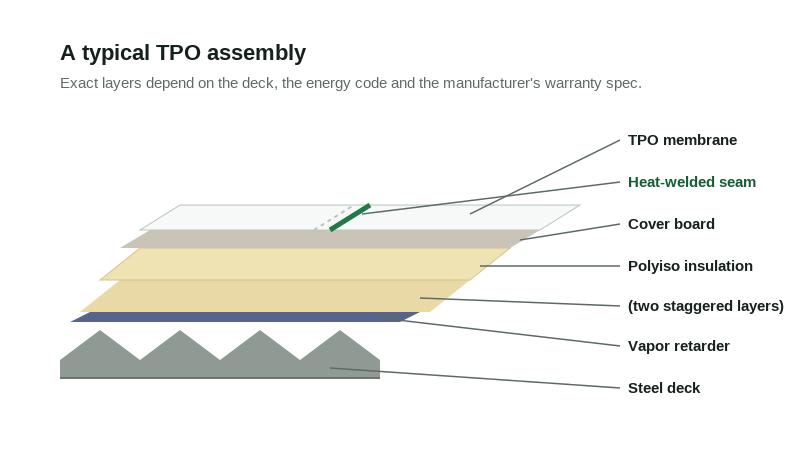
There are four common methods. The same choices apply to PVC membranes, which some contractors install. We install and repair TPO and EPDM.
What is a mechanically attached roof?
Screws and plates fasten the membrane through the insulation into the deck in rows along each seam, and the next sheet's lap covers them. On TPO, that lap is heat-welded; on EPDM, it's taped. Corners and perimeters get more rows, because wind uplift is strongest there.
- Strengths: the fastest to install, usually the lowest cost, few temperature limits and works over many deck types.
- Trade-offs: the sheet can billow between fastener rows in high wind, which works the fasteners and seams over time. Fasteners through soft insulation are more vulnerable under hail.
- What to listen for: some movement is normal. Loud billowing usually means air is getting under the sheet through an opening at an edge, seam or penetration.
What is an induction-welded roof?
The crew fastens plates through the insulation, lays the membrane over them and bonds it to the plate tops with an induction tool. Nothing pierces the membrane.
- Strengths: no penetrations through the sheet, wider sheets with fewer seams and good uplift ratings.
- Trade-offs: specialized equipment, some sheet movement between plates, and a plate layout that still has to follow the tested pattern.
What is a fully adhered roof?
Bonding adhesive goes on the cover board or insulation and the back of the membrane, and the whole sheet is bonded down. A variation uses a fleece-backed membrane set in low-rise foam adhesive or bonding adhesive.
- Strengths: the strongest hail and wind performance, no billowing and a quiet roof. Damage shows clearly, which makes inspection and repair easier. Fleece-backed sheets are the toughest against hail and punctures, tolerate rougher substrates and make a strong recover option.
- Trade-offs: higher cost, the highest with fleece-back. Adhesives have temperature and humidity limits that matter in a Colorado winter, and they need a clean, dry substrate. An adhered sheet doesn't billow, but the bond can let go in patches.
What is a ballasted roof?
The membrane is laid loose over the insulation and held down by weight, using river rock or concrete pavers. Ballast is most often seen on EPDM roofs.
- Strengths: quick to install with no adhesives to cure, and the ballast shields the membrane well from hail and sun.
- Trade-offs: the weight has to be carried by the structure, and ballast has height and wind-exposure limits. In a strong chinook or thunderstorm gust it can scour from corners and edges, leaving bare membrane and sending stones into drains. Leaks are harder to trace, because water travels under the loose sheet and the rock hides the surface.
Attachment methods side by side
| Method | Wind | Hail | Cold-weather install | Inspection and repair |
|---|---|---|---|---|
| Mechanically attached | Meets ratings with the right pattern; billows between rows | Weaker over soft insulation | Few limits | Straightforward; billowing points to openings |
| Induction welded | Good uplift ratings; some movement | Depends on the cover board | Few limits | Straightforward |
| Fully adhered | Strongest; no billowing | Strongest over a cover board | Adhesive temperature limits | Damage shows clearly |
| Fleece-back adhered | Strong | Toughest | Adhesive temperature and humidity windows | Damage shows clearly |
| Ballasted | Scour at corners and edges; height limits | Ballast shields the sheet | No adhesives | Hard to trace leaks; ballast must be moved |
How does each method handle wind?
Wind uplift ratings belong to a complete tested assembly. That means the deck, insulation, cover board, fasteners or adhesive and membrane, built a specific way. Each method can be designed to meet the rating your building needs. What changes is the attachment pattern and how the roof behaves along the way.
The building code also requires tested edge metal on low-slope membrane roofs. That's because most wind failures start at the edge. See wind uplift ratings and wind damage on commercial roofs.
Location matters. Buildings along the foothills, from Boulder through Golden and Lakewood, take the strongest chinook winds. Our page on commercial roofing in Golden covers what that means there. Office parks in the Denver Tech Center and Centennial see more thunderstorm outflow. Both pull hardest at corners and perimeters.
How does attachment affect hail damage?
Hail rarely punches straight through a single-ply membrane. More often it crushes the insulation or fractures its facer, leaving a soft spot that flexes until the membrane cracks.
An adhered sheet over a dense cover board spreads the impact and stays tight to the board. The weakest setup is a fastened sheet laid directly over soft insulation. Our guide to cover boards and hail explains that layer, and hail-resistant commercial roofing covers the whole assembly.
How do you choose a method?
- Start with the deck. Steel, wood, concrete and older gypsum decks each hold fasteners differently. On a recover, we test fastener pullout before choosing.
- Check the structure. Ballast is heavy. A lighter adhered assembly may be the better way to get performance on an older building.
- Weigh the exposure. If your building is tall, on open ground or in the foothill winds, lean toward adhered systems or tighter fastening patterns. Those conditions also limit where ballast can go.
- Look at hail history. A roof that has needed hail repairs before makes a stronger case for an adhered or fleece-backed sheet over a cover board.
- Plan for season and occupants. Adhesives have temperature limits and some odor. If you need winter work or have sensitive air intakes, plan ahead.
- Read the warranty. Your manufacturer warranty specifies the assembly, including attachment, for each term and upgrade.
On a recover, the ballast comes off first. A fleece-backed or mechanically attached sheet over a new cover board is common. For how attachment fits into the rest of the roof, see types of commercial roofing systems and TPO vs EPDM.
How do you maintain each type?
Maintenance looks a little different by method. On mechanically attached roofs, watch perimeter seams and listen for billowing in wind. On adhered roofs, look for patches where the bond has let go. On ballasted roofs, spread the rock back out after wind so no membrane is left bare. During inspections, move ballast in test areas.
Seams are where most single-ply roofs fail, whatever the attachment; see TPO and EPDM seam failures.
Weighing attachment options for a replacement or recover? We'll match the method to your deck, exposure and warranty, and price the options side by side. See TPO roofing and EPDM roofing, or request an assessment.
Single-ply attachment FAQs
Which attachment method is best for a Colorado roof?
There's no single answer. Fully adhered and fleece-backed systems over a cover board perform best in hail and don't billow in wind. But they cost more and have adhesive temperature limits. Mechanically attached roofs cost less and install in most weather. The deck, exposure and warranty decide.
Why does our roof membrane flap in the wind?
Some movement is normal on a mechanically attached roof. Loud billowing usually means air is getting under the sheet through an opening at an edge, seam or penetration. Have it checked before the next windstorm.
Is a ballasted roof a problem?
A ballasted roof isn't a problem by itself. Ballast shields the membrane from hail and sun. But wind can scour it from corners and edges, leaks are harder to trace, and the structure has to carry the weight. Regular inspections keep the rock where it belongs.
Can adhered roofs be installed in winter?
Yes, with planning. Adhesives have minimum temperatures, so we schedule around warmer days, keep materials warm or use cold-weather products. Mechanically attached systems have fewer limits.
Do you install PVC roofs?
No. PVC uses the same attachment methods, but we install TPO, EPDM, built-up, metal and spray foam roofs. We can show you how those compare for your building.