
Home / Resources / Temporary repairs after a storm
Temporary roof repairs after a storm
After hail or high wind, the first job is to stop the water. The second is to do it the right way. That means protecting the building, keeping the evidence intact and not creating new problems for the permanent repair. Here's what emergency mitigation on your commercial or association roof involves, and how to document it for the claim.
Why do temporary repairs matter?
On a low-slope roof, water that gets through a puncture or an open seam doesn't stay put. It spreads through the insulation, often well away from where it entered. Later it shows up as stains in a corridor, a tenant suite or a top-floor unit.
Wet insulation can't simply be patched over; it has to be found and replaced. The sooner the roof is closed up, the less there is to replace.
There's an insurance reason, too. Your policy likely expects you to take reasonable steps to prevent further damage after a loss. A prompt, documented temporary repair shows you did.
If water is coming in now, call us first at (720) 296-0000 or report a leak.
Before the crew arrives: what you can do inside
- Protect people first. Cordon off wet floors and keep people away from water near light fixtures or outlets. If it's safe to do so, shut off power to wet fixtures.
- Move what can be moved. Equipment, records, inventory and furniture away from the drip, with plastic over anything that can't be moved.
- Catch the water. Buckets and plastic sheeting, placed where they won't become trip hazards.
- Photograph and log. Each leak's location, the room or unit, when it started and whether it follows rain, hail, snowmelt or wind.
- Stay off the roof. Storm-damaged roofs are slick, edges and skylights may be broken, and hail can hide hazards. Leave the roof to a crew with fall protection.
- Get access ready. Roof hatch keys, gate codes, a contact on site and anything you know about rooftop equipment.
Our checklist for the first 72 hours after a hailstorm covers the rest of the first few days, including insurance notice and inspection.
What does emergency mitigation look like on a commercial roof?
Temporary work depends on what failed. These are the situations we see most after Front Range storms:
| Problem | Temporary step | What follows |
|---|---|---|
| Punctures and fractures in a membrane | Patches compatible with the membrane over each opening | Inspection of the insulation and cover board beneath; permanent patches or replacement |
| Open seams and laps | Sealed or temporarily covered | Seams probed and repaired properly |
| Lifted edge metal or coping | Re-secured and covered so wind can't get under the membrane | A tested edge system restored |
| Torn or blown-off membrane | Temporary membrane or sheeting, secured so it can't become a sail | Wet insulation removed; section or full replacement |
| Broken skylights | Covered and guarded, since an open skylight is also a fall hazard | New dome or unit, re-flashed |
| Damaged vents and caps | Openings closed off | Replacement parts; HVAC contractor for equipment |
| Drains clogged with hail and debris | Drains and scuppers cleared so water can leave the roof | Strainers and drain bodies checked for damage |
Clearing drains is easy to overlook. After a hailstorm, ice and shredded leaves pile up at drains and scuppers. Water that can't drain then ponds right where the roof may already be damaged.
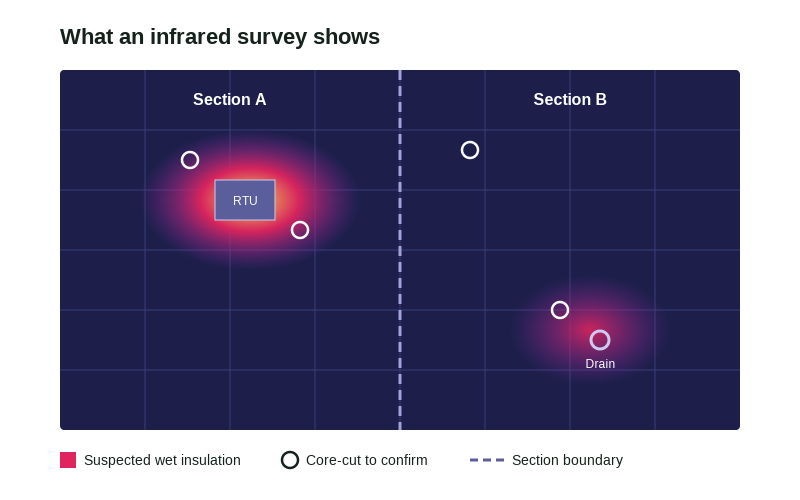
A temporary repair stops new water. It doesn't dry out what's already wet. Where water may have entered, an infrared moisture survey and core cuts show how far it spread. Then the permanent repair can replace all of the wet material.
Which repair materials suit your roof?
The wrong material can turn a temporary repair into a permanent problem. Asphalt-based roof cement isn't compatible with TPO or EPDM, and the permanent crew has to remove it.
Older built-up roofs may use coal tar pitch, which isn't compatible with asphalt repair products. Exposed spray foam needs its coating restored before UV attacks the foam. Metal roofs need compatible fasteners and sealants.
A crew that knows your system can often make a temporary repair that's easy to build on, not one that has to be torn out. When you call for emergency roofing services, ask whether the crew works on your type of roof.
We work on the systems you're likely to find on a commercial or association roof: TPO, EPDM, built-up, metal and spray foam.
How do you mitigate without destroying the evidence?
The temporary repair and the claim have to coexist. A few habits keep them from conflicting:
Photograph before and after
Every opening before it's covered, with a wide shot that shows where it is, and again after the repair.
Mark the location
Note each repair on a roof plan or site map, by building and roof section, so it can be matched to the inspection report.
Keep removed parts
A cracked skylight dome or crushed vent cap is evidence. Keep it until the adjuster has seen it or says it isn't needed.
Get an itemized invoice
Date, location, materials and labor, separate from any permanent work.
Hold permanent repairs
Wait for the adjuster to inspect before permanent repairs, unless waiting would cause more damage.
Our guide to documenting hail damage on a commercial roof covers the rest of the record. Our guide to using NOAA hail reports to establish a date of loss explains how to tie the damage to the storm.
When to stop at temporary, and when not to
Stop at a temporary repair when the adjuster hasn't seen the roof or the damage is part of a larger repair-or-replace decision. The same goes when materials have to be ordered, a board has to approve the work, or weather won't allow a proper permanent repair. Adhesives and some membrane work have temperature limits that matter in a Colorado winter.
What a temporary repair shouldn't become is permanent by default. Temporary patches and covers aren't built to last through freeze-thaw, high-altitude sun and the next hailstorm. Hail season runs from mid-April to mid-August, and a roof patched in May may face several more storms before the claim is settled.
Chinook gusts can strip a temporary cover, and snow hides whether it's still in place. Have your temporary repairs checked after every significant storm. Schedule the permanent work as soon as the scope is settled.
Where the storm exposed a roof near the end of its life, the decision may be bigger than a repair. Our guide to wind damage on commercial roofs covers when a blown-off section points to replacement. Our guide to ordinance or law coverage explains the code items a replacement can trigger.
Mitigation and your insurance claim
Notify your agent or carrier promptly, as your policy requires, and tell them what temporary repairs were made. Reasonable mitigation costs are often handled as part of the claim, but policies vary. Ask your agent what applies, and keep every invoice and photo.
Read anything a contractor asks you to sign after a storm. An emergency work agreement should describe the temporary work and its price. It shouldn't commit you to a full replacement or hand control of your claim to the contractor. Our page on storm chasers and commercial property lists the red flags.
We document the damage and the temporary repairs and prepare a detailed scope for the permanent work. When you ask us to, we meet the adjuster on the roof. We don't negotiate the claim; that's your role, with your agent or a licensed public adjuster.
No deductible deals. Truman never pays, waives or rebates a deductible on any job. Colorado's roofing contractor law forbids it on residential property, which can include condo and townhome buildings.
For associations and property managers
Emergency roof repairs often happen between board meetings. Your governing documents set who can approve them, and a manager should know that before the storm, not during it. Agree on approval limits with your roofer in advance. Then a crew can stop a leak on the spot and send a proposal for anything larger.
If your community has many damaged roofs, our guides to managing a hail claim across multiple buildings and association hail claims cover documentation, deductibles and resident updates. Our page for property managers explains how we handle leak calls across a portfolio.
Plan ahead for the next storm
- Keep roof access contacts, hatch keys and roof plans where the on-call person can find them.
- Have a roofer on file for roof leak repairs before hail season, with approval limits agreed.
- Keep a dated baseline of each roof's condition, so new damage is easy to separate from old.
- Keep drains clear going into storm season, so a storm's water and hail can leave the roof.
The NRCA recommends inspecting low-slope roofs twice a year and after severe weather. Our S.M.a.R.T. maintenance program includes drain clearing and a written report after every visit.
We're based in Centennial near the Denver Tech Center and work across the metro. See our commercial roofing in Centennial and Aurora pages. If water is coming in, report a leak or call (720) 296-0000; for an inspection after the storm, request one here.
Temporary repair FAQs
Will insurance pay for temporary repairs?
Reasonable mitigation costs are often part of the claim, but policies vary. Keep the photos and itemized invoice, and ask your agent how your policy handles them.
Should we make permanent repairs before the adjuster comes?
Generally not. Make temporary repairs to stop the water. Hold permanent repairs until the adjuster has inspected, unless waiting would cause more damage.
Can our maintenance staff put a tarp on the roof?
Not without fall protection and the right materials. A loose tarp on a low-slope roof can blow off in the next gust or hold water. Inside the building, your staff can do a lot: protect people and contents, catch water and document the leaks.
How long can a temporary repair stay in place?
Only until the permanent repair can be made. Temporary work isn't built for Colorado's freeze-thaw, sun and repeated storms. Have it checked after each storm, and schedule the permanent repair once the scope is settled.
What should we keep for the claim?
Keep before-and-after photos and the location of each repair. Also keep any damaged parts that were removed, the itemized invoice and your log of leaks and calls.
How quickly can you respond?
Call us first if water is coming in, and we'll tell you when a crew can be there. For non-urgent requests, we reply within one business day.