
Home / Resources / Roof asset management
Roof asset management for building portfolios
When you manage a dozen roofs, you can't remember each one. Roof asset management means one record per roof and the same inspection and report everywhere. It also means one plan that ranks repairs and replacements across the whole portfolio.
Why manage roofs as a portfolio?
Most managers inherit a patchwork. There's a different roofer at each property, warranties sit in someone's old email, and nobody recorded what was fixed last year. Every leak becomes its own emergency, and budgets get built on roof age because nobody has better information.
Managing roofs as assets changes that. Each roof gets a record. Each one is inspected the same way, on the same calendar.
Findings are ranked across the portfolio, so money goes to the roofs that need it most rather than to whichever building called last. And when an owner, board or lender asks about a roof, the answer is already written down.
What goes in a roof inventory?
The inventory is the foundation. Build one record per roof section, since one building can have several roofs of different ages and systems:
| Record | What to capture |
|---|---|
| Location | Property, building and roof section, with a simple roof plan |
| System | TPO, EPDM, built-up, metal, spray foam or other, and the number of roofs if known |
| History | Approximate install date, who installed it, and past repairs with dates and photos |
| Warranty | Manufacturer and workmanship warranties, expiration dates and the maintenance each requires |
| Features | Drains, scuppers, skylights, rooftop equipment and anything other trades service |
| Access | Hatch, ladder or stair location, keys, gate codes and the on-site contact |
| Condition | Latest condition by section, estimated remaining life as a range, and open items |
| Leaks | Every leak call, with date, location inside and the cause found on the roof |
If records are missing, a baseline inspection of each roof fills the gaps. Core cuts answer what's under the membrane when nobody knows, and drone photos help document roofs that are hard to reach safely.
How should you rate roof condition?
A portfolio only compares well if every roof is judged the same way. Ask for inspections that follow one checklist and one report format at every property. Each report should show condition by section, photos located on a roof plan, what was repaired and a prioritized list of what's next. Remaining life should be a range with the reasoning behind it, not a single number pulled from the roof's age. Our guide to roof survey and inspection reports lists what a complete report includes.
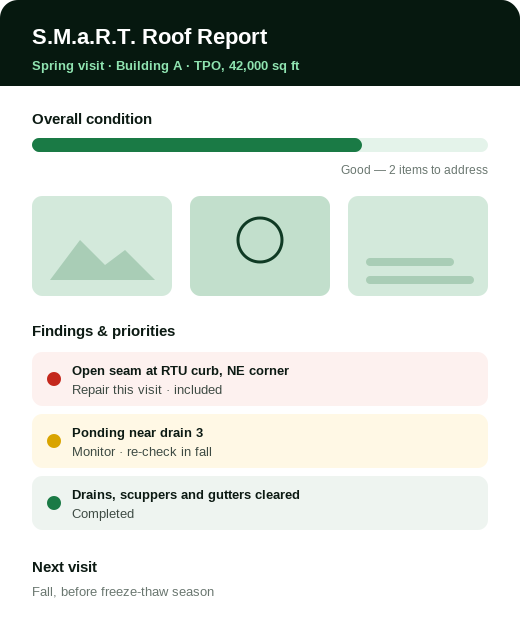
For low-slope roofs where the replace-or-repair question is coming, add an infrared moisture survey. Wet insulation is the difference between a roof you can repair for years and one that needs replacing. You can't see it from the surface. Our inspection services page explains the options.
How do you rank the work?
With every roof rated the same way, you can rank findings by risk across the portfolio instead of building by building:
Act now
Active leaks, open seams or flashings, storm damage that will get worse, and unsafe access or edges.
Fix this year
Problems that aren't leaking yet but will: dried sealant, punctures, clogged drains and loose edge metal.
Maintain
Routine work that keeps roofs performing: debris removal, drain cleaning and small repairs on scheduled visits.
Plan for replacement
Sections with widespread wear or wet insulation, scheduled into the capital plan by year.
Monitor
Items to recheck on the next visit, with photos so changes are easy to see.
This ranking is what you take to owners and boards. It shows why one building's roof gets money this year and another's waits, in terms people can follow.
How do you put every roof on one maintenance calendar?
Most leaks start at small things that scheduled visits catch: clogged drains, opened seams and loose flashings. Our S.M.a.R.T. maintenance program (Service, Maintenance and Repair with Truman) gives you one roof maintenance plan for the whole portfolio. Each roof gets visits twice a year, as NRCA recommends, plus checks after severe weather:
- Level 1, Clear & Check: drain and gutter cleaning, a visual inspection and a written report. Often right for newer roofs under warranty.
- Level 2, Clear & Repair: everything in Level 1, plus debris removal and small general repairs during the visit. Fits most working roofs.
- Level 3, Survey & Repair: everything in Level 2, plus a full inspection, a roof survey and medium general repairs. Suited to older roofs and capital planning.
Different properties can sit at different levels. We group visits by area, so one spring and fall round covers the whole portfolio. Approval limits for each property tell the crew when to fix on the spot and when to send a proposal first.
How should you budget for roofs?
Roof spending falls into two budgets, and the data feeds both:
- Operating budget: maintenance and repairs for the coming year. Size it from each roof's age, condition and open items, not last year's number.
- Capital plan or reserves: replacements by year, based on remaining-life ranges from inspections. If you run an association, that's your roof input to the reserve study. See HOA reserve planning.
A portfolio view also makes phasing possible. If you replace two roofs in the same area in the same year, they can share setup and the cost of bringing in crews and equipment. Spreading replacements across budget years also keeps the worst roofs from waiting until the end. For what moves the price of each project, see commercial roof cost factors.
How do you keep track of warranties and lease duties?
Warranties are easy to lose track of across many buildings. Keep each one with its roof record, and note what maintenance it requires and when it expires. Then schedule a warranty inspection before it ends, so covered defects get reported while they're still covered. Our guide to roof maintenance and your manufacturer warranty covers what manufacturers usually ask for.
On leased buildings, check each lease for who maintains, repairs and replaces the roof. Responsibilities differ from lease to lease. If your roof record notes them, you'll save arguments after a leak.
How do you plan for storms across a portfolio?
Hail season along the Front Range runs roughly mid-April to mid-August. One storm can hit several of your properties at once, and the first question is which roofs got hit and how hard. If you have spring baseline photos, a building list and access details for every roof, your portfolio gets inspected and documented much faster.
A drone roof inspection can show quickly which buildings need a full hands-on look. For associations, our guide to association hail claims covers the claim process. For what to do first, see the first 72 hours after hail.
What should you look for in roof asset management services?
- Experience with every system in your portfolio, on roofs they didn't install
- One report format for every property, and roof records you can keep
- One point of contact who knows how each owner or board approves work
- Certificates of insurance on file: we carry $2M general liability, a $5M umbrella and workers' comp on every employee
- A local team that will still be around for warranty calls years after the work is done
Our page for community and property managers explains how we set up a new portfolio. It runs from the property list to the first round of baseline inspections. Andrew Rickert leads our estimating. He's a CPA and a Class-A licensed contractor, so your condition data comes back in a form finance teams can use.
Managing roofs across the Denver metro? From our office near the Denver Tech Center, we serve buildings from Centennial to Aurora and beyond. Contact our team with your property list. We'll recommend a baseline inspection plan and a maintenance level for each roof.
Roof asset management FAQs
What's the first step for a portfolio with no roof records?
Start with a baseline inspection of each roof. It gives you a roof plan, the system, condition by section and any warranty details. That becomes the first version of each roof record.
How often should each roof be inspected?
Twice a year, as NRCA recommends for low-slope roofs, plus after severe weather such as hail, high wind or heavy snow. See how often to inspect a commercial roof.
Can different buildings be on different maintenance levels?
Yes. A newer roof under warranty may only need Level 1. An older roof heading toward replacement fits Level 3. Levels can change as roofs age.
Do you work on roofs you didn't install?
Yes. We maintain and repair TPO, EPDM, built-up, metal and spray foam roofs regardless of who installed them.
Can you format reports for owners, lenders or boards?
Yes. We'll summarize condition by building, capital needs by year and documented repairs. You can take that to an asset manager, a lender or a board meeting.