
Home / Resources / Roof repair guide
Commercial roof repair: common problems and fixes
Most commercial roof repair comes down to a short list of problems. You'll see them again and again on offices, warehouses, retail centers and association buildings. Here's what each one is, what fixing it properly involves, and when repairs stop making sense.
What are the rules behind every good repair?
- Find the source, not the stain. Water can travel under a membrane, along deck flutes and through insulation before you see it inside. The opening is often well away from the drip. Our guide to why commercial roofs leak explains how a source is traced.
- Fix the cause. A seam that opened because water ponds against it will open again unless the drainage is fixed too.
- Check what's underneath. A patch over wet insulation stops the drip and leaves the damage. Wet insulation has to be found and replaced.
Repairs also come in two kinds. A temporary repair stops water during a storm, or when conditions won't let permanent materials bond. A permanent repair uses the right materials for the roof system and should last as long as the roof around it.
If water is coming in now, call (720) 296-0000 or report a leak. Then read our guide to emergency roof repairs to see what to expect.
What problems cause most repairs?
Here are the conditions we repair most often on low-slope commercial and multifamily roofs. They're listed roughly in order of how often they cause leaks.
Flashing failures
Flashings seal the roof where it meets walls, curbs, edges and pipes, and they take more movement and sun than any other part of the roof. Base flashings pull away from parapets, termination bars loosen, sealant dries out and counterflashings come loose. Most leaks start here.
The repair: small openings are cleaned and resealed or patched with matching materials. If a flashing has shrunk, split or slumped, we remove it and tie new flashing into the membrane. Where needed, we add a new termination bar and counterflashing. See roof flashing failures and repairs.
Seam failures on single-ply roofs
On TPO, seams are heat-welded; on EPDM, they're joined with tape or adhesive. Underwelded TPO seams, aging EPDM seam tape, ponding water and building movement all open laps over time.
The repair: TPO seams are cleaned, prepared and rewelded, or covered with a welded cover strip if the membrane still takes a reliable weld. EPDM seams are cleaned, primed and covered with seam tape or a cover strip. Caulk along an open seam isn't a repair. See seam failures on TPO and EPDM roofs.
Ponding and blocked drainage
Water that sits on a roof after it should have drained works into seams and adds weight. In winter it freezes against flashings, and over time it shortens the membrane's life. The cause can be as simple as a drain clogged with leaves or as deep as a sagging deck.
The repair: start by clearing drains, scuppers and gutters and replacing missing strainers. Crickets or tapered insulation move water toward drains. In bigger cases, we add drains or overflow scuppers. See ponding water on a flat roof and flat roof drainage.
Punctures and foot traffic damage
Dropped screws and tools, HVAC panels set on the membrane, ladder feet, ice chippers and snow shovels puncture single-ply roofs. Service routes to rooftop units take the most damage.
The repair: a patch of the same membrane, welded on TPO or primed and adhered on EPDM, extending well past the damage. If water got in, the wet insulation beneath is replaced first. Walkway pads along service routes prevent repeats.
Rooftop units and curbs
Several things lead to water around rooftop equipment. Look for curbs that are too short and flashing that's split or shrunk at the corners. Missing crickets on the uphill side, loose unit panels and condensate lines draining onto the roof cause leaks too. Some "leaks" there are condensate, not the roof.
The repair: re-flash the curb, add a cricket to divert water, re-secure panels and reroute condensate. A unit replacement is the best time to fix the curb itself. See leaks around rooftop HVAC curbs.
Pipes, vents and pitch pans
Pipe boots crack in the sun, clamps loosen, and pitch pans lose their fill and pull away from the pipe or support they surround. Each is a small detail with a direct path into the building.
The repair: we install new pipe flashings matched to the membrane. Pitch pans get refilled, or better, replaced with factory-made flashings where the penetration allows.
Parapets, coping and edge metal
Coping joints open, wall caps lose their fasteners, and water gets into the top of the wall and runs down behind the flashing. At the roof edge, wind lifts edge metal and peels back the membrane under it.
The repair: reseal or replace coping joints, re-secure or replace edge metal and coping, and repair the wall flashing below. See parapet wall and coping leaks and wind damage to commercial roofs.
Blisters, splits and alligatoring on built-up roofs
On built-up and modified bitumen roofs, trapped air or moisture forms blisters. Exposed bitumen cracks under UV, and ridges over insulation joints can split. Gravel scoured from corners leaves bare spots that age fast.
The repair: small, intact blisters are usually marked and watched. We cut out cracked, soft or growing blisters and patch them with new plies. Bare spots get fresh bitumen and gravel, and worn smooth surfaces are recoated. See roof blisters and built-up roof repair and restoration.
Metal roof fasteners, laps and seams
On metal roofs, the panels usually outlast the screws, washers, lap sealant and trim. Leaks follow the threads of backed-out screws and the hardened sealant in panel laps.
The repair: oversized replacement fasteners with new washers, resealed laps, new closures and rebuilt penetration flashings. See commercial metal roof leaks.
Spray foam coating wear and damage
A foam roof is only as good as its coating. UV wears it thin, hail fractures it and birds peck through it.
The repair: cut out damaged or wet foam, rebuild with new foam and coat it, and recoat the whole roof before the foam is exposed. See spray foam roof damage and repair.
Hail damage
Hail season along the Front Range runs from mid-April to mid-August. On low-slope roofs, hail often crushes insulation and fractures the cover board without breaking the membrane. So the roof may not leak until freeze-thaw opens it later.
Document every repair after hail with the storm date. Hold permanent repairs until the adjuster has seen the roof, unless waiting would cause more damage. See our guides to hail on TPO, EPDM, built-up and metal roofs, and the first 72 hours after a hailstorm.
Wet insulation: the hidden one
Every problem above can let water into the insulation, where it stays out of sight. Wet insulation loses its insulating value and adds weight. It can corrode a steel deck, and it keeps feeding leaks after the opening is closed.
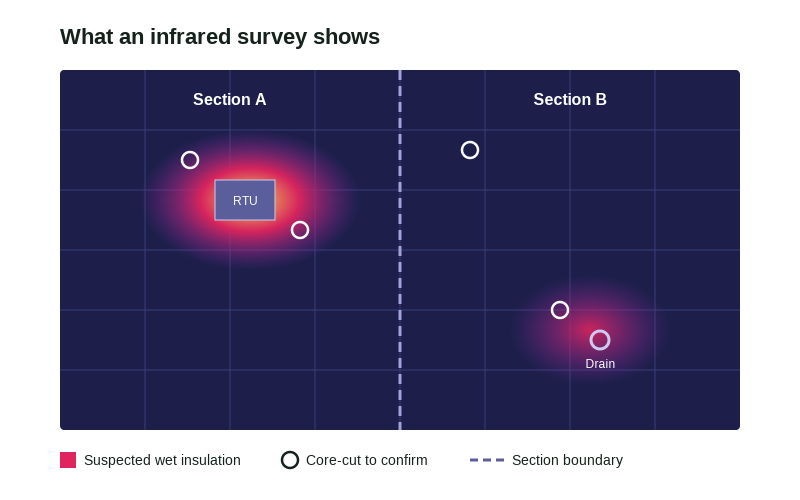
The repair: we find it with an infrared moisture survey and core cuts. Then we cut out the wet sections, replace them with dry insulation and patch the membrane. See wet insulation under a flat roof.
How should a commercial roofing repair visit go?
Leak history
Where water shows up inside, when, and what the weather was doing.
Trace the source
Work from the interior location to the roof above and upslope from it, checking every likely detail.
Check for moisture
We probe, core or survey wherever water may have reached the insulation.
Repair with matching materials
Welded TPO on TPO, primed tape and patches on EPDM, plies on built-up, compatible coatings on foam.
Photo report
The cause, the repair, its location on a roof plan and anything else that's close to failing.
If your roof is under a manufacturer warranty, an authorized contractor usually has to make the repairs. They also have to be reported to the manufacturer. Tell us about the warranty first so a repair doesn't put coverage at risk.
Which repairs don't last?
- Mastic or caulk over everything. It hides problems for a season and makes the real repair harder, especially on TPO, where it blocks future welds.
- Patching the spot above the stain without tracing the source.
- Patching over wet insulation, or coating a roof that hasn't been checked for moisture.
- Mismatched materials, such as asphalt products on a coal tar roof or the wrong coating over silicone.
Repair, restore or replace?
Repairs make sense while your problems are isolated and the insulation is mostly dry. Sometimes leaks keep appearing in new places, seams fail across the roof, or a survey shows widespread wet insulation. At that point, more patches are money spent on a roof that's ending.
Restoration options such as recoating spray foam or re-graveling a built-up roof can add years to a sound roof. Our guide to repair or replace covers the signs, and roof recover vs tear-off covers the next choice. For what moves the price of each option, see commercial roof cost factors.
How does Colorado weather shape repairs?
UV at altitude dries out sealants and flashings faster than at sea level. Freeze-thaw widens small openings every winter. Chinook winds lift edges and corners, and heavy spring snow drifts against parapets and units, then melts into clogged drains.
Repairs also have seasons. Adhesives, sealants and coatings have temperature limits. So some permanent repairs wait for a warmer, dry day after a temporary fix.
How do you get fewer, smaller repairs?
Most of the problems above start small. The NRCA recommends inspecting low-slope roofs at least twice a year and after severe weather. On our S.M.a.R.T. maintenance program, we clear drains and make small repairs during the visit. You get a written report with photos, so problems are caught before they reach the insulation.
We repair TPO, EPDM, built-up, metal and spray foam roofs, whoever installed them. You'll find our crews on commercial, HOA and multifamily buildings, from DTC office parks to condo communities.
For commercial roof repair in Denver and the communities within about 30 miles, see commercial roofing in Centennial or our work in Denver. Then request an inspection.
Roof repair FAQs
Can you repair a roof another contractor installed?
Yes. We repair roofs regardless of who installed them. If the roof is under a manufacturer warranty, we check its requirements first.
Why did our leak come back after it was patched?
Usually the patch went where the water showed up, not where it got in. Or wet insulation, or an underlying cause such as ponding, was left in place.
How do we know if repairs are still worth it?
Watch for leaks that keep appearing in new places, seams or flashings failing across the roof, or a survey that shows widespread wet insulation. If you see any of those, it's time to compare repair against recover and replacement.
What does a roof repair cost?
It depends on the system, the cause, how much wet insulation has to come out, access and the season. We quote after we've seen the roof and traced the problem.
Can repairs be made in winter?
Many can. Some materials have temperature limits, though. In that case, we make a temporary repair and come back on a warmer, dry day for the permanent one.